
Walk into a wellness shop today and you'll likely see herbs like ashwagandha, reishi, chamomile, burdock, ginger, and astragalus sitting side by side. Some are rooted in Traditional Chinese Medicine (TCM), while others come from Western herbalism, Ayurveda, or Indigenous healing traditions. At first glance, they may seem interchangeable, but each tradition has its own philosophy, language, and way of understanding health.
So what exactly is the difference between Western herbalism and Traditional Chinese Medicine? And how does Rasāsvāda bring these traditions together?
Key Takeaways
- Traditional Chinese Medicine (TCM) is a complete medical system that views health as the balance of Qi, Yin and Yang, and the interconnected function of organ systems.
- Western herbalism focuses on the medicinal properties of individual plants and how they support specific body systems and overall wellness.
- TCM typically uses custom herbal formulas, while Western herbalism often emphasizes single herbs or simpler blends.
- TCM classifies herbs by energetic qualities such as temperature, flavor, and meridian affinity rather than only by their chemical constituents.
- Modern research increasingly supports many herbs used in both traditions, particularly in the fields of healthy aging, stress resilience, immune function, and metabolic health.
- Rasāsvāda thoughtfully combines herbs from both traditions, honoring their history while embracing modern botanical science.
What Is Traditional Chinese Medicine (TCM)?
Traditional Chinese Medicine is one of the world's oldest continuously practiced systems of medicine, with written records dating back more than 2,000 years and roots extending even further into Chinese history.
Unlike Western medicine, which often identifies a single disease or diagnosis, TCM asks a different question:
Why has the body become imbalanced?
Rather than viewing organs as isolated structures, TCM sees the body as an interconnected network where physical, emotional, environmental, and energetic factors constantly influence one another.
Its foundational concepts include:
- Qi (vital energy): The life force that circulates throughout the body.
- Yin and Yang: Complementary forces that must remain in dynamic balance.
- The Five Elements: Wood, Fire, Earth, Metal, and Water—used to understand relationships between organ systems, emotions, seasons, and natural cycles.
- Pattern differentiation: Instead of treating a disease label alone, practitioners identify patterns of imbalance unique to each individual.
In this framework, two people with similar symptoms may receive completely different herbal formulas depending on the underlying pattern.
What Is Western (Botanical) Herbalism?
Western herbalism has its roots in ancient Greece, Rome, Medieval European apothecaries, Indigenous European folk traditions, and later North American herbal practices.
Rather than relying on energetic diagnostic systems like Qi or the Five Elements, Western herbalism traditionally focuses on the medicinal actions of plants and body systems (digestive, nervous, respiratory, cardiovascular, etc.).
Modern Western herbalists often combine centuries of traditional knowledge with contemporary phytochemistry and clinical research. For example, a Western herbalist might choose chamomile to promote relaxation, milk thistle for liver health, or burdock root for detox support.
These plants are often selected for their known physiological actions and active constituents, while still respecting traditional uses.

Different Philosophies, Shared Goals
Although these systems use different languages, they share remarkably similar goals.
Both aim to support the body's natural resilience, promote long-term wellness instead of simply masking symptoms, and restore balance rather than force the body in one direction.
The biggest difference lies in how they explain these processes: Western herbalism often describes herbs through modern physiology and plant chemistry, whereas TCM describes herbs through energetic relationships and patterns of imbalance.
How TCM Classifies Herbs
One of the defining characteristics of TCM is its sophisticated system for categorizing herbs. Instead of focusing solely on chemical compounds, herbs are classified by several energetic properties.

Temperature
Herbs may be considered hot, warm, neutral, cool, or cold. These properties are used to help restore energetic balance. For example, cooling herbs may traditionally be used when excess internal "heat" is present, while warming herbs may be chosen for patterns associated with "cold."

Flavor
Each herb also has one or more flavors that correspond with particular actions. Common flavors include sweet, bitter, sour, pungent, and salty. These flavors are believed to influence different physiological functions and organ systems.

Meridian Affinity
TCM also identifies which organ systems—or meridians—a particular herb primarily supports. For example, an herb may traditionally enter the lung, liver, spleen, or kidney meridian. These classifications help practitioners build balanced formulas tailored to each individual.
TCM Uses Herbal Formulas
One of the biggest differences between TCM and Western herbalism is that TCM rarely relies on a single herb. Instead, practitioners combine herbs into formulas where each ingredient serves a specific purpose.
A traditional formula often includes a chief, deputy, assistant, and envoy herb. Each herb addresses the primary imbalance, supports or harmonizes with other herbs, or “guides” to specific meridians and blends. This layered approach reflects TCM's belief that herbs work synergistically and that balance is achieved through thoughtful combinations rather than isolated ingredients.
While Western herbalists also create blends, single-herb preparations are more common.
The Growing Connection Between TCM and Longevity Science
Modern longevity research has sparked renewed interest in many herbs long valued in TCM.
Scientists are studying how certain botanicals may support healthy aging by influencing pathways related to oxidative stress and immune function. They focus on cellular resistance, inflammation, and metabolic health.
For example, reishi has been studied for immune modulation and healthy aging, and schisandra berry has attracted interest for its antioxidant and adaptogenic properties. While much of this research is ongoing, it highlights an exciting convergence between traditional herbal knowledge and modern biomedical science.
Where Rasāsvāda Fits In
At Rasāsvāda, herbal wisdom isn't confined to one tradition.
Instead, the brand draws inspiration from multiple healing systems (including Traditional Chinese Medicine, Western herbalism, Ayurveda, and modern botanical research) to create balanced, thoughtfully crafted blends.
You might find TCM-inspired botanicals alongside Western herbal favorites. Each ingredient is chosen not because it belongs to a particular tradition, but because of its long history of use, complementary role in the formula, and emerging scientific evidence.
This integrative approach reflects Rasāsvāda's philosophy: honoring ancient traditions while embracing modern understanding. Every elixir is inspired by this shared botanical heritage—bringing together ancient traditions and modern science in a way that is both intentional and approachable.
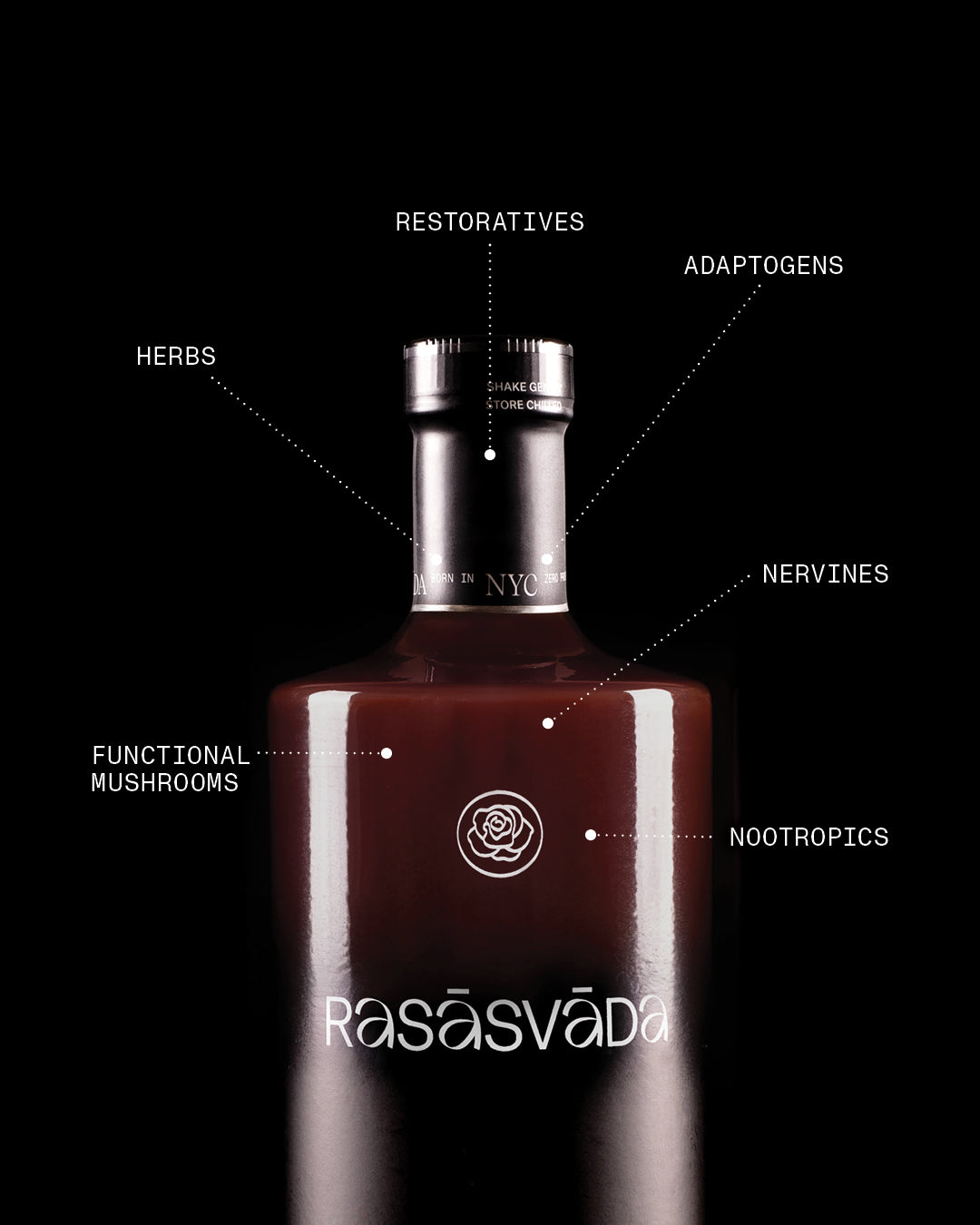
Zero-proof Rasāsvāda combines cutting-edge longevity science with expertly sourced herbs, adaptogens, and functional mushrooms. Discover the transformative power of adaptogens and experience a new way to drink—one that nourishes both body and mind.
100% plants. 0% preservatives.