
Before wellness became an industry and supplements lined the shelves of health-food stores, there were people who worked with plants in a very different way. They gathered roots, leaves, berries, flowers, barks, seeds, and resins. They dried them, ground them, steeped them, cooked them, infused them, fermented them, and combined them according to generations of accumulated knowledge.
Eventually, some of these practitioners became known as apothecaries.
The apothecary tradition grew out of something older than the profession itself: the human practice of turning plants into preparations. Across civilizations, botanical knowledge was preserved not only through written texts, but through recipes, rituals, observation, and careful attention to how an ingredient was prepared.
Today, as interest in botanical wellness, longevity, and traditional herbal practices continues to grow, these ideas can feel surprisingly contemporary. However, the underlying practice is anything but new.
Key Takeaways
- Apothecary traditions grew from the ancient practice of turning plants and other natural materials into prepared remedies, long before apothecaries became a formal profession.
- Botanical preparation developed across many cultures, including ancient Egypt, Greece and Rome, and Traditional Chinese Medicine.
- How plants are prepared has historically been an important part of herbal traditions, with methods including decoctions, infusions, tinctures, syrups, oils, and tonics.
- Apothecaries became a distinct profession in medieval Europe and eventually helped pave the way for modern pharmacy.
- Advances in chemistry, pharmacology, manufacturing, and scientific medicine during the 18th and 19th centuries shifted medicine toward standardized preparations and defined active compounds, though traditional herbal practices continued around the world.
- Today’s interest in botanical wellness brings together traditional knowledge of plants and preparation methods with modern research into their compounds, mechanisms, and potential effects.
What Is an Apothecary?
The word apothecary has roots in the Greek apothēkē, meaning a storehouse or repository. Over time, the term came to describe people who stored, prepared, and sold medicinal substances.
Ancient medical practitioners worked with an astonishing range of natural materials, including plants, minerals, and animal-derived substances. They developed methods for transforming these raw materials into preparations that could be stored, administered, and combined in particular ways. By the medieval period, apothecaries had emerged as a distinct profession in parts of Europe, eventually becoming an important precursor to the modern pharmacist.
It’s important to note that the history of botanical preparation doesn't belong to a single culture or medical system, though.
Ancient Roots: The First Herbal Traditions
Long before the first European apothecary shops appeared, sophisticated systems of herbal medicine were already developing across the ancient world.
Egypt: The Ebers Papyrus
One of the most important surviving records of ancient Egyptian medicine is the Ebers Papyrus, a medical text dating to around the 16th century BCE. While it’s not an apothecary manual in the modern sense, the underlying practice is at the heart of later apothecary traditions. The document contains hundreds of prescriptions and provides a remarkable window into Egyptian approaches to healing.
Additionally, preparations described in ancient Egyptian medical texts could contain botanical, mineral, and animal-derived ingredients. Plants and other materials were prepared in different ways and combined with substances such as water, beer, wine, honey, milk, and oils.
Greece and Rome: Building a Materia Medica
The botanical knowledge of the ancient Mediterranean was further organized and expanded by Greek and Roman-era physicians and writers.
Among the most influential was Pedanius Dioscorides, a Greek physician who lived during the first century CE. His five-volume work, De Materia Medica, described hundreds of medicinal plants and other natural substances, including their preparations and uses.
De Materia Medica shaped European and Mediterranean herbal medicine for centuries, and later medical texts continued to draw on its botanical knowledge. Research comparing historical materia medica has found remarkable continuity between Dioscorides' work and European herbal traditions that followed.
Dioscorides' contribution was more than a catalog of plants. His work documented what substances were used, which parts of plants were employed, how they were prepared, and how they were administered.
Preparation as part of the knowledge of a plant would become central to apothecary practice.
Traditional Chinese Medicine and the Decoction Tradition
In Traditional Chinese Medicine (TCM), herbal knowledge developed along its own long and sophisticated path, with an emphasis on formulas, preparation methods, and the relationships between individual ingredients.
One of the defining characteristics of Chinese herbal medicine is the use of formulas rather than isolated ingredients. Different herbs may be combined according to their traditional roles within a preparation, creating a formulation that is understood as a whole. They achieve this through many different ways, but primarily decoction is used.
A decoction is created by preparing plant material in water, traditionally through cooking. The process allows compounds from the herbs to move into the water, creating a concentrated botanical preparation.
The method is simple in appearance, but it represents an important idea: how a plant is prepared is part of the tradition of working with it.
That principle is particularly relevant to Rasāsvāda. Its Spirit Restoratives are made from whole plants and prepared using a slow-cooking, decoction-based process inspired by traditional herbal practices.

The Medieval and Renaissance Apothecary
By the medieval period, the apothecary was becoming a recognizable figure in European cities. Apothecaries stored and prepared medicinal materials and eventually became increasingly distinct from physicians. In many places, guild systems helped regulate the profession and establish standards around who could practice and what could be sold.
The apothecary shop became a place where botanical knowledge became tangible. Shelves were lined with dried roots, seeds, flowers, spices, powders, oils, and other ingredients. The apothecary's work involved knowing these materials: identifying them, storing them properly, measuring them, and preparing them into usable forms.
This was the era in which many of the preparations associated with the apothecary tradition became familiar, including infusions, decoctions, tinctures, syrups, electuaries, oils, and tonics. The term elixir also entered the lexicon of pharmacy and alchemy, although its meaning varied across different periods and traditions.
When Apothecary Became Pharmacy
During the 18th and 19th centuries, advances in chemistry, pharmacology, manufacturing, and scientific medicine transformed the way medicinal substances were understood and produced.
Some compounds could be isolated from plants. Others could be synthesized. Standardized preparations could be manufactured at increasing scale. Eventually, pharmaceutical production moved far beyond the small shop and its collection of jars and handwritten recipes. It also changed the relationship between people and botanical preparations.
The traditional apothecary was intimately connected to ingredients and preparation. Industrial pharmaceutical production increasingly emphasized standardization, reproducibility, scalability, and precisely defined active compounds.
Neither approach tells the entire story of medicine. But the transition helps explain why the older language of tinctures, tonics, decoctions, and herbal elixirs eventually began to feel like something from another era.
The knowledge itself, however, never completely disappeared. Traditional herbal practices continued in cultures around the world, and many of the plants described in historical materia medica remain subjects of contemporary botanical and pharmacological research.

The Return to Botanical Wellness
Today, botanical wellness is having a moment.
Interest in herbs, adaptogens, mushrooms, polyphenols, and other functional botanicals may be expressed in modern scientific language, but the underlying curiosity is ancient: What can plants offer, and how can we work with them thoughtfully?
Modern researchers can investigate individual compounds, mechanisms of action, antioxidant activity, cellular pathways, and other measurable characteristics. At the same time, traditional systems continue to offer centuries of knowledge about plants, combinations, preparation methods, and sensory experience.
The two perspectives don't have to be opposites; in fact, some of today's most interesting botanical research exists at their intersection. For Rasāsvāda, that intersection is central to the philosophy behind its Spirit Restoratives: traditional herbal wisdom paired with contemporary longevity research, using whole plants, herbs, adaptogens, and functional mushrooms.

The Apothecary Tradition, Reimagined
At Rasāsvāda, the apothecary tradition takes a modern form. The Spirit Restoratives are made entirely from plants and use a slow-cooking process designed to draw out the character of whole botanicals.
Ruby Artemisia brings together botanicals including artemisia, maqui berry, red wine grape skins, and Yunnan Pu'er tea in a bright, tart, bittersweet expression. Rose Bergamot combines botanicals including ginseng, rose, schisandra berry, and bergamot for a floral, citrus-forward profile. Black Ginger takes a darker, earthier direction with black ginger, burdock root, cardamom, and mushrooms including reishi and meshima.
Each is distinctly modern but is grounded in the apothecary tradition, which is why the recent botanical movement feels less like a departure from the past than a continuation of a history.
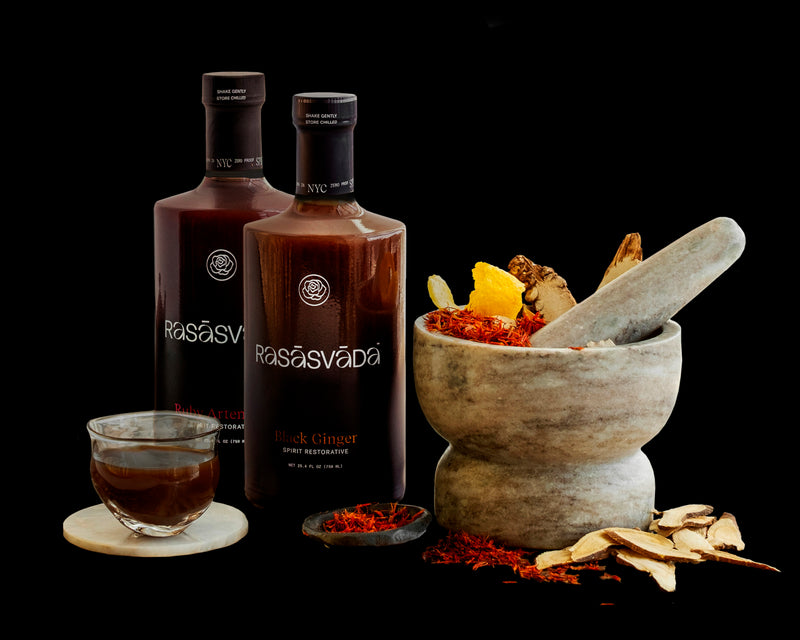
The Power of Traditional Plants–Ready to Pour
Discover all three Rasāsvāda expressions with one 375ml bottle each of Ruby Artemisia, Black Ginger, and Rose Bergamot.
- Whole plants, thoughtfully sourced from six continents, wild-harvested and handpicked at peak potency.
- Slowly simmered using traditional methods with layered decoctions of roots, bark, seeds, and other botanicals.
- Rooted in tradition, backed by modern science combining herbal wisdom with the rigor of longevity research.
FAQs
Disclaimer
This content is for educational purposes only and is not intended as medical advice. Consult a qualified healthcare professional before starting any new herbal regimen, especially if you are pregnant, nursing, having existing medical conditions, or taking medication.
100% plants. 0% preservatives.